
In Part One, we explored how strong service recovery, when done right, can be a strategy to drive accelerated revenue growth, especially when external pressures such as tariffs tighten margins due to inevitable price hikes, in turn testing customer loyalty and satisfaction. Now, we’ll dive even deeper. Because there’s another critical lever brands can’t afford to overlook, customer-led digital transformation.
Change is nothing new. But the pace? That’s what’s rewriting the rules. Faster consumers, faster decisions, and even faster consequences for brands that fall behind. Digitization has continued to arm consumers with more and more power. And when it comes to brand awareness, it’s a double-edged sword. Consumers can find your brand quickly but can leave for a competitor just as fast. If your digital transformation doesn’t start with the consumer, you’re not digitizing, you’re drifting away.
That’s why digital transformation must be customer-led. It should be built around how customers behave now and designed to be flexible enough to evolve with them tomorrow. From faster self-service to more intuitive personalization, the brands winning today are the ones moving at the speed of the customer.
The problem is, under pressure to move fast, brands often focus inward and lose sight of their most important source of value, the customer. The result? Wasted investment on fancy new interfaces that aren’t user-intuitive, and fleeting customers because digital touchpoints and experiences weren’t designed with their interests and preferences at the forefront.
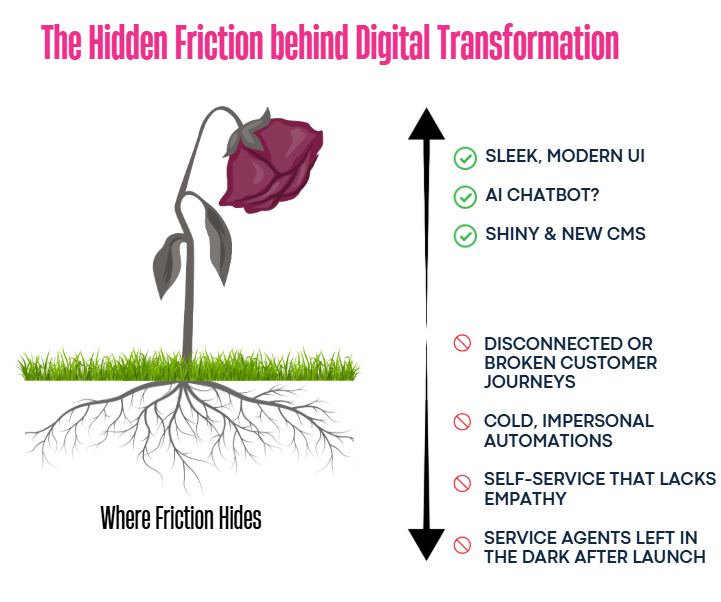
The key to keeping pace without losing sight of the customer? Build lean, agile, cross-functional teams with the insight and perspective to look ahead and navigate change from all angles, while staying grounded in what matters most.
This second installment in the Retention to Ruin Series highlights why market leaders are bringing the customer-first approach to digital transformation to build loyalty, accelerate adoption, and unlock scalable growth, and how you can do the same.
Here are five strategies for leveling up by bringing the customer with you, so you’re not left swimming upstream.
🔹 Embed CX into Digital Strategy from the Very Beginning
🎯 Why it works:
When customer experience leaders are brought in early, before technical planning begins, they reshape how problems are framed. Instead of solving internal pain points (e.g. system inefficiencies), leading companies put the customer at the center to uncover where friction exists, so CX can be improved, and value can be added. This creates alignment between business goals and user expectations, reduces rework, increases perceived value, and speeds up sales.
Embedding CX in every touchpoint from day one prevents transformation from becoming a bloated IT project and makes it a tool for retention, satisfaction, and market differentiation.
🛠️ How to implement it:
- Include CX, support, and frontline leaders in every digital roadmap conversation, not just IT.
- Build agile cross-functional teams where every sprint includes real user feedback.
💡 ZELOCIN™ Insight: Brands that embed customer insight early into digital planning through customer feedback collection are 1.5x more likely to launch on time and under budget. Why? Because when you build with real customer pain points in mind, you avoid costly fixes later. CX-first aligns teams, reduces rework, and keeps momentum. Tech-first skips the ‘why’ and ends up solving problems that matter less to the consumer, ultimately stalling business growth.
CX from the Jump in Action: USAA
USAA, the financial services company serving military members and their families, builds customer experience into the foundation of every digital initiative. Before any major rollout, USAA includes customer feedback loops and frontline service insights directly into its agile development process. For example, when redesigning its mobile app, veterans were involved in user testing from day one, leading to features like easy deployment updates and faster claims processing. The result? A mobile experience ranked #1 in customer satisfaction by J.D. Power, and a blueprint for embedding CX early to reduce friction and increase adoption.
🔹 Use Data to Personalize
🎯 Why it works:
Data for digital transformation is only as valuable as the experience it improves. When brands over-automate, they risk depersonalizing the journey, leading to robotic interactions, tone-deaf recommendations, and customer churn. When you use customer data to deliver the right message, at the right time to the right customer, you create a sense of recognition and value through relevance that motivates repeat behavior.
🛠️ How to implement it:
- Tap into first-party data to deliver contextually relevant interactions across channels.
- Map content and product recommendations not only to customer segments and journey stages, but also to users’ preferred communication channels, whether that’s SMS, email, or both.
💡 ZELOCIN™ Insight: Personalization rooted in real-time customer data can increase conversion by 20%+ and reduce churn by up to 40%.
Additionally, Customers are 80% more likely to purchase from brands that offer personalized experiences. And personalized CX leads directly to revenue lift and deeper loyalty.
Personalization in Action: Sephora
Sephora, a leader in cosmetics retail, uses first-party data from its Beauty Insider loyalty program to deliver highly personalized product recommendations, email campaigns, and even in-store experiences. Rather than relying on generic automations, Sephora maps its messaging to customer behavior and journey stages, recommending the right products at the right time based on preferences, past purchases, and even skin tone. This data-led omnichannel personalization provides relevance for the customer. The Beauty Insider Program has contributed to Sephora’s roughly 80% retention rate, 3x greater member spend vs non-loyalty members, and 22% increase in cross-sell revenue.
🔹 Design from the Outside-In
🎯 Why it works:
When brands are faced with the urgency to catch up, internal processes and systems often evolve around what’s easy for the business, not what’s intuitive for the customer. Designing “from the inside out” creates fragmented, frustrating experiences. In contrast, when you map the journey from the customer’s point of view, you uncover emotional drivers, unmet needs, and friction points that would otherwise go unnoticed. This insight allows brands to prioritize digital improvements that matter most. Those that simplify, streamline, or surprise. It also avoids investing in features no one uses.
🛠️ How to implement it:
- Map real customer journeys across channels, not silos.
- Identify where tech enables clarity or creates confusion, then simplify ruthlessly.
💡 ZELOCIN™ Insight: Companies that prioritize journey mapping see 54% greater return on their digital investments. Fix the flow, and aggressive growth will follow.
Starting with the Customer In Action: Airbnb
Airbnb radically redesigned its host onboarding process after mapping it from the host’s perspective. Instead of focusing on internal data fields, they prioritized ease, clarity, and emotional reassurance, which is what first-time hosts truly need. By simplifying the sign-up, adding host success stories, and providing upfront pricing suggestions, Airbnb reduced onboarding time by 50% and significantly increased listing volume. The change proved that designing from the outside-in not only improves UX but also unlocks scalable supply-side growth.
🔹 Break Down Silos Between Tech and Service
🎯 Why it works:
When customer-facing teams aren’t looped into digital decisions, the experience suffers. Service teams are left scrambling to support tools they didn’t help design, while developers miss out on frontline insights that could have improved the build. The result? Low adoption, slow resolution times, and costly rework. But when tech and service collaborate, digital tools reflect real customer needs and practical workflows. It reduces friction for customers and empowers teams to deliver consistent, confident support.
🛠️ How to implement it:
- Align IT, CX, and service teams around shared KPIs in cross-functional dashboards and include frontline teams in testing and feedback loops for every rollout.
💡 ZELOCIN™ Insight: Cross-functional teams outperform siloed ones by 35%+ in delivering cohesive digital experiences. Internal alignment shows up externally as brand trust.
Cross-Functional Teams In Action:
A significant portion of Slack’s success can be attributed to its alignment between product and support. Before every major product update, Slack includes customer experience and support teams in testing and rollout planning. That collaboration has helped reduce ticket volume at launch, improved time-to-resolution, and ensured support reps are equipped with knowledge, not surprises. The internal alignment shows: Slack consistently ranks among the top SaaS tools for customer satisfaction.
🔹 Make Digital Self-Service Feel Human
🎯 Why it works:
Speed matters. But in a crowded marketplace, speed without empathy leads to churn. Customers are willing to use self-service tools, but only if the experience feels easy, intuitive, and human. Language, design, and optional human backup all play a role in shaping emotional outcomes. A chatbot with personality, clear microcopy, or a warm confirmation message can turn a simple task into proof of delivering on brand promise. When your self-service experience feels like an extension of your brand, not a replacement for support, you build loyalty while reducing cost.
🛠️ How to implement it:
- Build self-service flows that mirror real conversations. Use microcopy that’s friendly, not formal, and design prompts that guide users like a helpful rep would. Instead of “Submit,” try “Let’s get started.” Instead of “Error 404,” try “Oops – let’s fix this together.”
- Add human backup where it counts, like live chat options after repeated failed searches or a real rep follow-up after high-friction actions (e.g. returns, cancellations) to show customers they’re not on their own, even when starting with self-service.
💡 ZELOCIN™ Insight: Humanized digital experiences can boost CSAT by 19% and double engagement on self-service platforms. Emotionally resonant tech delivers measurable growth.
Self-Service In Action: Duolingo
Duolingo’s app is a masterclass in humanized self-service. Through gamified design, light humor, and friendly reminders delivered in the brand’s quirky tone, Duolingo transforms repetitive language practice into an emotionally resonant experience. The app’s self-service nature is powered by automation—but it never feels robotic. Users stay engaged longer, return more often, and are more likely to upgrade to paid plans, showing how emotional design boosts both retention and revenue.
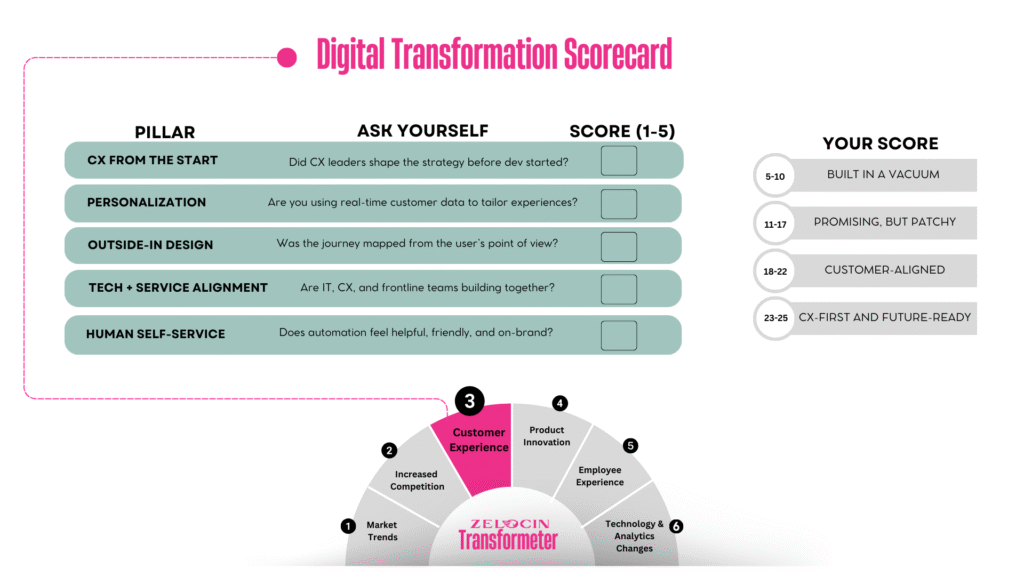
🔍 Growth Insight:
Customer-Led Transformation Accelerates ROI. Brands that treat digital transformation as a tech checklist often find themselves fixing what customers never asked for. But when you take the time to slow down and understand customer pain points, expectations, and values, you unlock higher ROI, faster rollout, and deeper loyalty.
Customer-centric digital transformations deliver:
📈 2x revenue growth
💬 20–30% higher satisfaction scores
⚡ 30–50% faster adoption and time to value
In uncertain markets, that’s not just operational success. That’s a competitive advantage.
📊 The Bottom Line:
Digital transformation is your growth engine only if it’s built around the customer. In a world that continues to move faster, take a second to respond instead of jumping to react. Start by knowing your customer better than anyone else, and everything else follows. The brands that listen are the brands that win.
🌱 Ready to digitize for impact? Let’s build a roadmap that starts with your customer.